
What’s In This Guide
- Are Solid Wood Bathroom Vanities a Good Fit for Bathroom Conditions?
- Why the Bathroom Environment Matters for Solid Wood Vanities
- Solid Wood vs. Other Vanity Materials: What Actually Differs
- Planning a Solid Wood Vanity: What to Confirm Before Installation
- What Affects the Cost of a Solid Wood Vanity Installation
- When Should a Homeowner Call a Professional?
- Frequently Asked Questions
- Ready to Explore a Solid Wood Vanity for Your Bathroom Remodel?
Choosing a vanity for a bathroom remodel usually comes down to one question: will it hold up? Solid wood bathroom vanities carry a reputation for warmth and durability, but bathrooms are also one of the most demanding environments in the home for any wood product.
Understanding how solid wood actually performs under daily splashing, humidity swings, and heavy use helps homeowners make a decision that fits their space, not just their style preference.
Quick Facts
- Uncontrolled moisture exposure poses a major risk. Solid wood bathroom vanities perform more reliably when finishes are properly sealed and humidity levels remain controlled.
- Ventilation quality significantly impacts vanity longevity. Inadequate ventilation increases the risk of warping or finish wear on a solid wood vanity.
- Drawer construction and joinery affect long-term function. Solid wood movement around drawer boxes and face frames requires proper joinery to help prevent sticking or gapping over time.
- Sink and plumbing clearances affect cabinet design. Undermount sinks, faucet spacing, and P-trap access all shape how a solid wood vanity cabinet gets built.
- Finish maintenance and care require attention over time. Promptly wiping away standing water and maintaining the finish protect the investment over the life of the bathroom.
Are Solid Wood Bathroom Vanities a Good Fit for Bathroom Conditions?
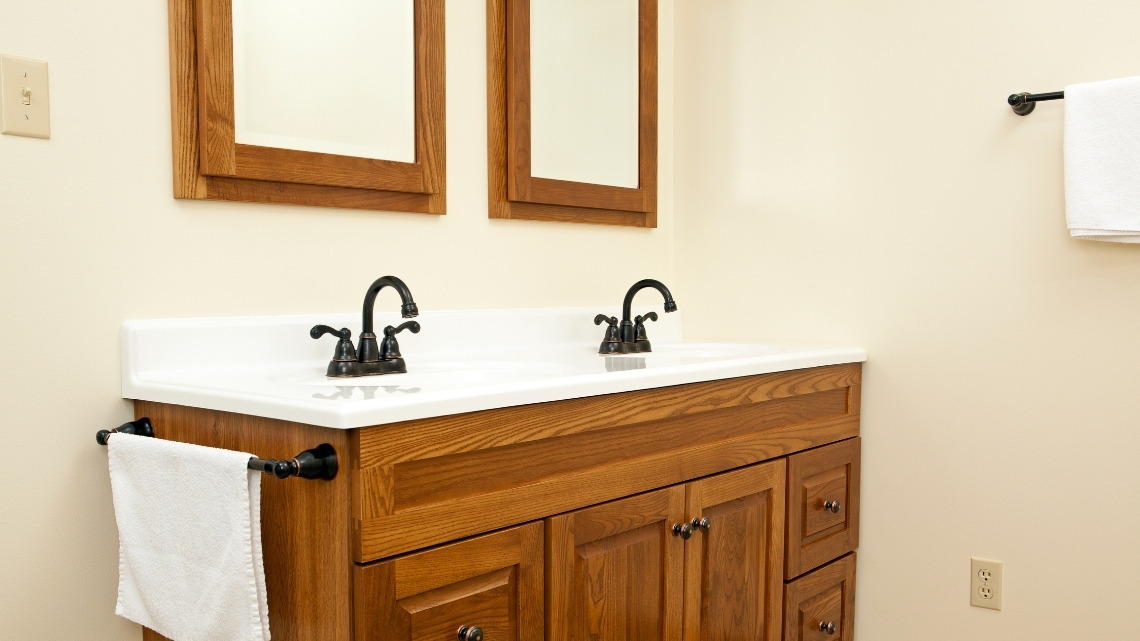
Solid wood bathroom vanities can perform reliably in residential bathrooms when properly constructed, thoroughly sealed, and supported by adequate ventilation. The natural material itself is not inherently unsuitable for bathroom environments; rather, unmanaged moisture exposure poses a major risk.
Wood is a hygroscopic material, meaning it absorbs and releases moisture in response to changes in relative humidity. According to wood movement research published by Purdue University’s forestry extension, wood reaches an equilibrium moisture content that shifts with relative humidity, which is why solid wood expands and contracts seasonally even indoors.
This means a solid wood vanity in a Fairfield County bathroom will respond to the same humidity swings that affect hardwood flooring or wood trim elsewhere in the home. The difference is that a full bathroom routinely experiences sharper spikes in relative humidity during showers, making high-quality finishes and reliable ventilation important for long-term performance.
A wood bathroom vanity with a properly sealed finish, quality joinery, and adequate ventilation tends to maintain its condition better over time than one placed in a poorly vented, highly humid room.
Why the Bathroom Environment Matters for Solid Wood Vanities
The long-term performance of a solid wood vanity depends heavily on its environment. Species selection matters, but moisture control is a critical factor.
Several bathroom-specific conditions put extra demand on any wood cabinetry:
- Standing water at the base. Water that pools at the cabinet toe kick or around the sink cutout can lead to finish wear and localized wood swelling if left unaddressed.
- Steam accumulation. Frequent hot showers in an inadequately ventilated room can keep relative humidity elevated, increasing moisture exposure around cabinet finishes and unsealed surfaces.
- Temperature and humidity swings. Hot, humid showers can create rapid changes in surrounding conditions, causing solid wood to absorb and release moisture and contributing to dimensional movement over time.
- Inadequate ventilation. Bathrooms with inadequate ventilation can retain moisture longer, extending the time wood remains exposed to elevated moisture levels. Missing or undersized exhaust fans can contribute to inadequate moisture removal.
The EPA notes that removing excess moisture through proper ventilation helps prevent mold and mildew growth in bathrooms, emphasizing that exhaust fans should vent directly outside rather than into an attic or interior space.
Solid Wood vs. Other Vanity Materials: What Actually Differs
Comparing solid wood bathroom cabinets to engineered alternatives comes down to how each material responds to moisture, not which one looks more premium. Every option has trade-offs worth weighing before a final decision.
| Material | Moisture Response | Key Material Characteristics | Maintenance Considerations |
|---|---|---|---|
| Solid wood bathroom vanities | Expands and contracts with humidity changes | Can be sanded and refinished over time | Requires prompt water cleanup and finish upkeep |
| Plywood with wood veneer | Cross-grain construction resists dimensional movement | Stable structural core with real wood surface appearance | Veneer thickness limits extensive sanding or refinishing |
| MDF with laminate or paint | Uniform material density, vulnerable if moisture penetrates seams | Provides a smooth base for painted finishes | Requires edge seal protection to prevent swelling |
| Particleboard | Susceptible to swelling when exposed to moisture | Economical core material | Needs careful protection from water intrusion |
Solid wood offers specific advantages and considerations compared to engineered options, making surrounding room conditions an important factor in material selection.
A solid wood vanity installed in a powder room with light, occasional use experiences far different demands than one placed in a primary bathroom shared by a family. Matching the material to the room’s actual usage pattern helps guide a sound material choice.
READ MORE: How Much Does a Master Bathroom Remodel Cost?
Planning a Solid Wood Vanity: What to Confirm Before Installation
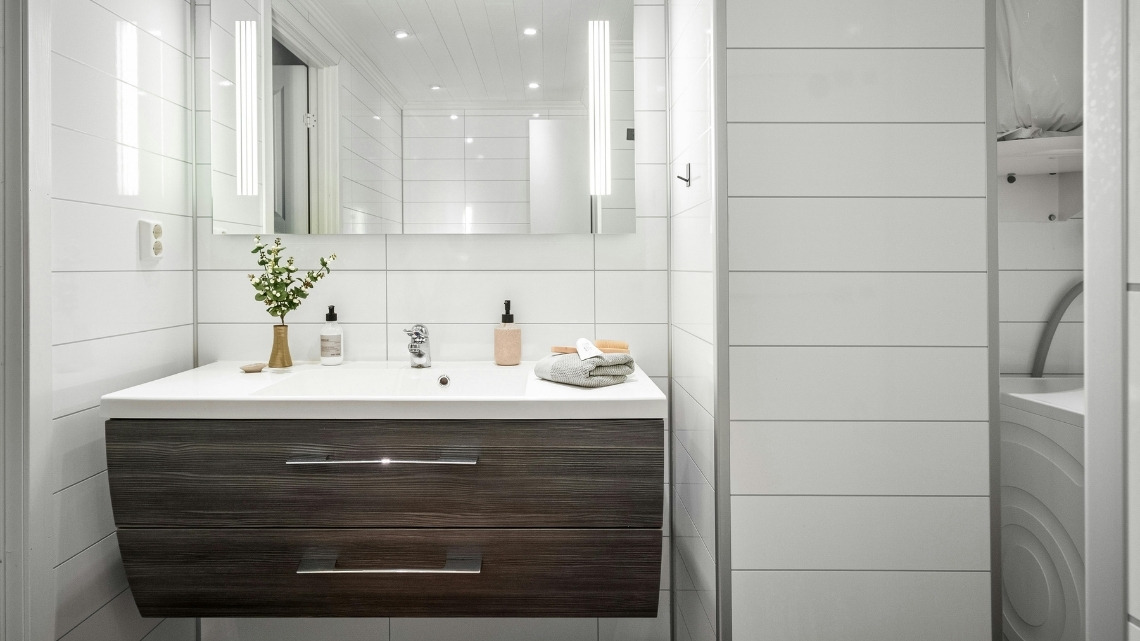
A solid wood bathroom vanity performs best when several design details are confirmed before the cabinet is built or installed.
Finish and Sealant Quality
A moisture-resistant sealed finish on all sides of the cabinet, including the back panel and interior, reduces the wood’s exposure to ambient humidity. Finishes that only coat visible surfaces leave unsealed areas vulnerable.
Drawer and Door Joinery
Solid wood drawer boxes and face frames benefit from joinery methods designed to accommodate natural seasonal movement. Cabinetry crafted without accounting for expansion and contraction can bind during humid weather or gap when conditions dry out.
Sink and Plumbing Clearances
Undermount and vessel sinks each require different cabinet cutouts, and plumbing access for the P-trap, supply lines, and shutoff valves needs to be planned into the cabinet interior. A cabinet designed around the wrong sink style often requires costly rework.
Ventilation Assessment
Before installation, it’s worth evaluating the bathroom’s exhaust fan capacity and ducting to ensure adequate moisture removal, as consistent airflow helps protect cabinetry finishes.
Storage Configuration
Determining the drawer count, shelf depth, and whether the cabinet needs to accommodate plumbing offsets should happen during the initial design phase. Reworking a finished piece to accommodate plumbing after delivery is significantly more disruptive than planning for it from the start.
What Affects the Cost of a Solid Wood Vanity Installation
The cost of a solid wood bathroom vanity depends on several project-specific factors, and it may range from a modest cosmetic swap to a significant investment depending on scope. There isn’t a single price that applies to every bathroom.
Factors that typically influence the estimate include:
- Wood species and grade selected
- Cabinet size, drawer count, and custom storage configuration
- Whether plumbing needs to be relocated or adjusted for the new footprint
- Sink and countertop pairing, including undermount versus vessel styles
- Site accessibility and existing bathroom conditions
- Labor requirements for installation, sealing, and finish work
- Any additional ventilation or electrical updates needed alongside the vanity
Because these variables shift from home to home, the most reliable way to understand what a solid wood vanity will cost in a specific Fairfield County bathroom is a walkthrough with a registered Home Improvement Contractor to assess the overall remodeling scope. Appropriately licensed trade professionals should evaluate any regulated plumbing or electrical work.
When Should a Homeowner Call a Professional?
A registered Home Improvement Contractor should handle the overall remodeling scope and structural adaptations, while appropriately licensed trade professionals should perform plumbing, electrical, or other regulated trade work. Professional evaluation is especially important when replacing a vanity in a bathroom with known moisture issues.
Signs that professional evaluation should come before any wood vanity purchase:
- Persistent musty odors or visible mold around the current vanity or baseboards
- Soft, discolored, or swollen material on the existing cabinet
- An exhaust fan that seems undersized, noisy, or absent altogether
- Uneven or sloped flooring near the vanity location
- Plans to change sink style, cabinet footprint, or plumbing layout
Working with a registered Home Improvement Contractor and any required licensed trade professionals helps ensure that relevant ventilation, plumbing, and site conditions are evaluated together, which matters because these factors interact directly with how well a solid wood vanity will perform over time.
Frequently Asked Questions
Can an existing countertop be reused with a new solid wood vanity?
Possibly. The existing countertop must match the new cabinet’s width, depth, sink location, faucet configuration, and support requirements. A contractor should also check the countertop for damage before designing the new vanity around it.
Can a solid wood vanity be refinished if the surface becomes worn?
In most cases, yes. A key advantage of solid wood bathroom cabinets is that minor scratches, worn finishes, and localized surface damage can often be repaired or refinished rather than requiring complete replacement. The exact repair options depend on the damage depth and original finish type.
Does a solid wood vanity need to acclimate before installation?
Acclimation requirements vary by the cabinet manufacturer and construction method. Because wood responds to surrounding humidity, the vanity should be stored and installed according to the manufacturer’s instructions rather than being moved directly from an uncontrolled storage environment into immediate installation.
Can a solid wood vanity be wall-mounted instead of floor-mounted?
It can, provided the vanity is designed for wall mounting and the wall structure can support its weight along with the countertop, sink, and stored items. Proper blocking and fastening should be planned before installation rather than added after the finished wall is complete.
How can homeowners tell whether vanity damage is cosmetic or moisture-related?
Minor surface scratches or normal finish wear may be cosmetic, while swelling, soft wood, separating joints, discoloration, or persistent musty odors can point to ongoing moisture exposure. The source of the moisture should be identified before repairing or refinishing the cabinet.
Ready to Explore a Solid Wood Vanity for Your Bathroom Remodel?
Grain & Steel Contracting LLC works with Fairfield County homeowners to plan bathroom remodels where cabinetry, ventilation, and plumbing are evaluated together rather than treated as separate decisions.
A brief consultation provides the clearest way to determine whether a solid wood vanity aligns with your bathroom’s layout, plumbing infrastructure, and ventilation setup.