
What’s In This Guide
- What Is a Cabinet Box, and Where Does Plywood Come In?
- Why Cabinet Box Construction Affects Strength, Moisture Performance, and Longevity
- Plywood Cabinet Boxes vs. Particleboard and MDF: How They Compare
- Warning Signs of a Weak Cabinet Box
- What to Check Before Choosing Cabinets: A Buyer’s Checklist
- What Affects the Cost of Plywood Cabinet Boxes?
- When Should You Call a Professional?
- Frequently Asked Questions
- Ready to Plan Cabinetry Built to Last in Your Kitchen?
When shopping for new kitchen cabinetry, homeowners often focus on door styles, finishes, and decorative hardware. However, the structural box behind those doors plays a far more critical role in determining how well your kitchen cupboards perform over time.
That distinction is critical. The cabinet box, also known as the carcass, supports every shelf, drawer, and heavy stack of dishware in your kitchen. If the box flexes, swells, or pulls apart at the joints, even the most elegant door cannot compensate for structural failure.
In all plywood cabinets and other kitchen cupboards, plywood cabinet boxes can offer greater strength and moisture resistance than standard particleboard boxes. Understanding why, and knowing what to check before signing a cabinet order, helps Fairfield County homeowners reduce the risk of cabinet construction problems.
Quick Facts
- Cabinet-grade plywood boxes generally provide strong screw-holding performance, dimensional stability, and resistance to shelf sagging, although performance depends on panel thickness, grade, span, and fastening.
- High-moisture zones near kitchen sinks and dishwashers can benefit from plywood or other moisture-resistant box materials.
- Panel thickness, back panel construction, joinery method, and core material all affect overall box rigidity.
- Signs of box problems include sagging shelves, swollen panels, loose hardware, and misaligned doors.
- Always verify core material, panel thickness, joinery quality, and shelf support before ordering.
What Is a Cabinet Box, and Where Does Plywood Come In?
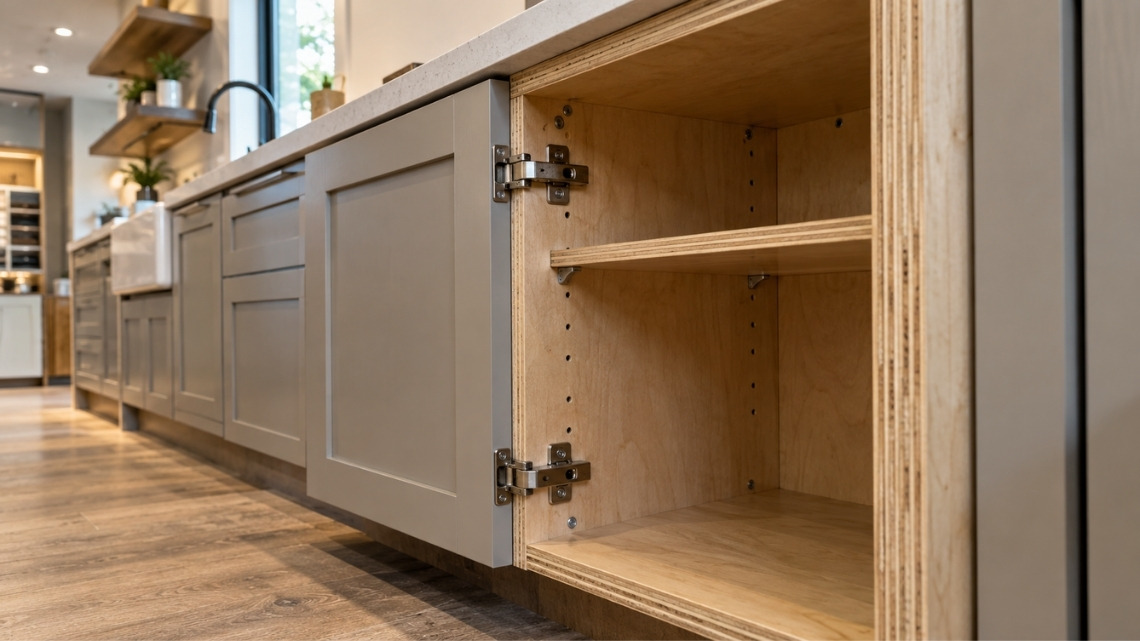
A cabinet box is the structural shell behind the visible door, drawer front, and hardware. It includes the sides, bottom, top rail, back panel, and interior shelving that support everything stored inside the cabinet.
Kitchen cupboard plywood uses layered construction, with wood veneers arranged so the grain direction alternates between adjacent plies. This cross-laminated construction provides strength and stiffness in multiple directions. Veneer species, core construction, and adhesive bond vary by plywood grade and product.
When evaluating all plywood cabinets, verify which primary box components are actually made from plywood, including:
- Cabinet sides, which support shelf brackets and drawer glides
- Bottoms, which bear the weight of stored items
- Shelves, which can flex under sustained load if the material is too thin for the span
- Back panels, which help square and stabilize the entire box
Why Cabinet Box Construction Affects Strength, Moisture Performance, and Longevity
Cabinet box material and overall construction affect how well plywood kitchen cupboards hold hardware, handle moisture, and carry weight over time. This matters in active kitchens, where cabinets face daily use, load stress, and environmental factors.
Structural Strength and Weight Support
Heavy cookware, small appliances, and stacked dishes put continuous load stress on cabinet shelves and bottom panels. Materials with lower bending stiffness, such as particleboard, are susceptible to sagging under sustained weight over time.
Plywood’s layered construction provides bending stiffness and structural stability under load. This cross-grained structure ensures outstanding fastener-holding performance across cross-laminated wood panels, keeping heavy-duty cabinet hinges, drawer glides, and shelf supports firmly anchored over decades of continuous use.
Moisture Resistance Near Sinks and Dishwashers
Kitchen environments naturally encounter moisture and steam. Cabinet boxes near sinks and dishwashers face an increased risk of swelling, warping, and panel degradation if constructed from moisture-sensitive materials.
Plywood generally handles incidental moisture exposure better than standard particleboard, which is more vulnerable to swelling when it absorbs water. Plywood performance under moisture exposure depends on the panel construction and adhesive bond, and plywood should not be treated as waterproof.
Long-Term Hardware Performance
Soft-close hinges and full-extension drawer glides rely on a stable mounting surface and solid fastener-holding strength to function correctly over time. When screws are driven into materials with lower holding power, hardware can loosen, causing doors or drawers to misalign.
Plywood Cabinet Boxes vs. Particleboard and MDF: How They Compare
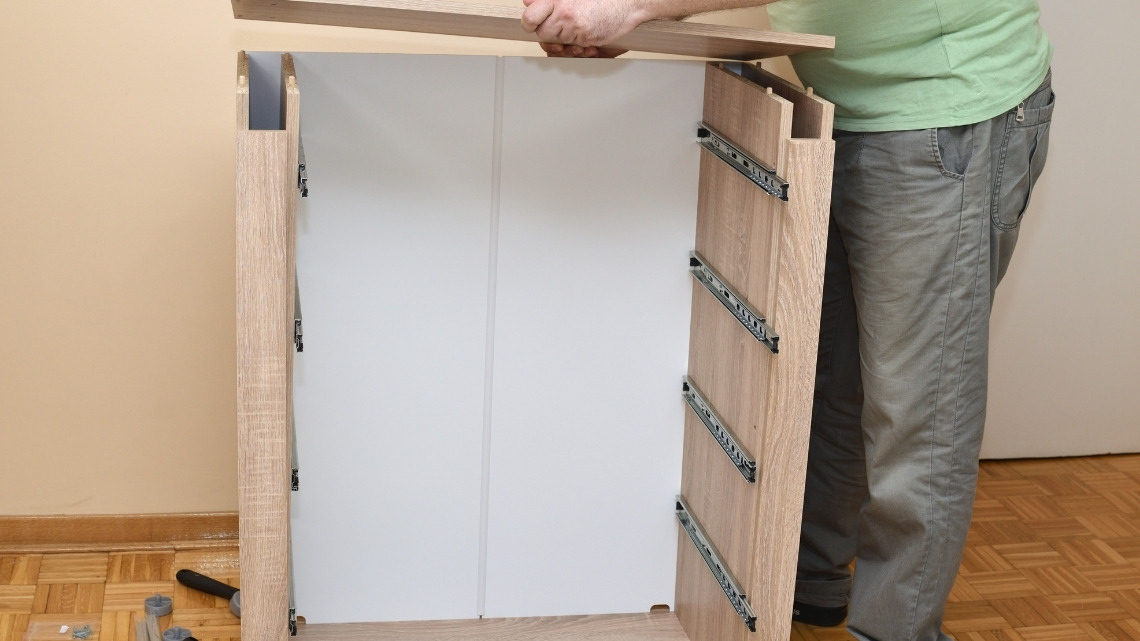
Plywood, particleboard, and MDF each offer distinct performance characteristics in an active kitchen. The side-by-side comparison below details how these core materials perform across key operational criteria.
Factor | Plywood | Particleboard | MDF |
Structural strength | High; cross-laminated layers resist flexing and sagging | Lower bending stiffness; prone to sagging under heavy loads | Moderate stiffness; dense but heavy |
Moisture resistance | High; handles incidental moisture exposure better than particleboard | Low; vulnerable to water absorption and permanent swelling | Moderate; edges are vulnerable to moisture absorption |
Screw and hardware holding | Strong holding power across layered veneers | Lower holding power; screws can strip if over-tightened | Moderate; holds well on faces but weaker along raw edges |
Weight | Lighter weight relative to structural strength | Heavier than plywood | Heaviest engineered wood core material |
Typical use in cabinetry | Box sides, bottoms, shelves | Budget cabinet boxes, shelving | Painted doors, drawer fronts |
Particleboard and MDF are composite engineered wood products made from wood particles or fibers bonded with synthetic resin binders. In the United States, all composite wood panels used in cabinetry must comply with strict federal formaldehyde emission standards for composite wood products under TSCA Title VI.
Homeowners focused on indoor air quality should verify that any composite core materials or MDF door profiles meet TSCA Title VI certification standards, ensuring low indoor emissions alongside robust plywood box construction.
READ MORE: Kitchen Remodeling in Fairfield County: What Homeowners Should Expect Before Hiring a Contractor
Warning Signs of a Weak Cabinet Box
Several visible conditions can signal cabinet box weakness or failure. Identifying these warning signs early helps homeowners determine whether minor repairs or full cabinet replacement is appropriate.
- Sagging shelves, especially in upper cabinets holding plates or glassware
- Swollen or delaminating panels near the sink base or dishwasher cabinet
- Screws that spin freely instead of tightening into hinges or drawer glides
- Visible gaps or separation at the corner joints of the box
- A soft or spongy feel when pressing on the cabinet bottom or sides
- Doors that no longer close flush or hang straight, which can result from hardware problems or a cabinet box that has racked or shifted out of square
These warning signs often point to structural or material issues rather than simple alignment problems. Depending on the extent of damage, repair options may range from hardware re-anchoring to replacing affected cabinet boxes.
What to Check Before Choosing Cabinets: A Buyer’s Checklist
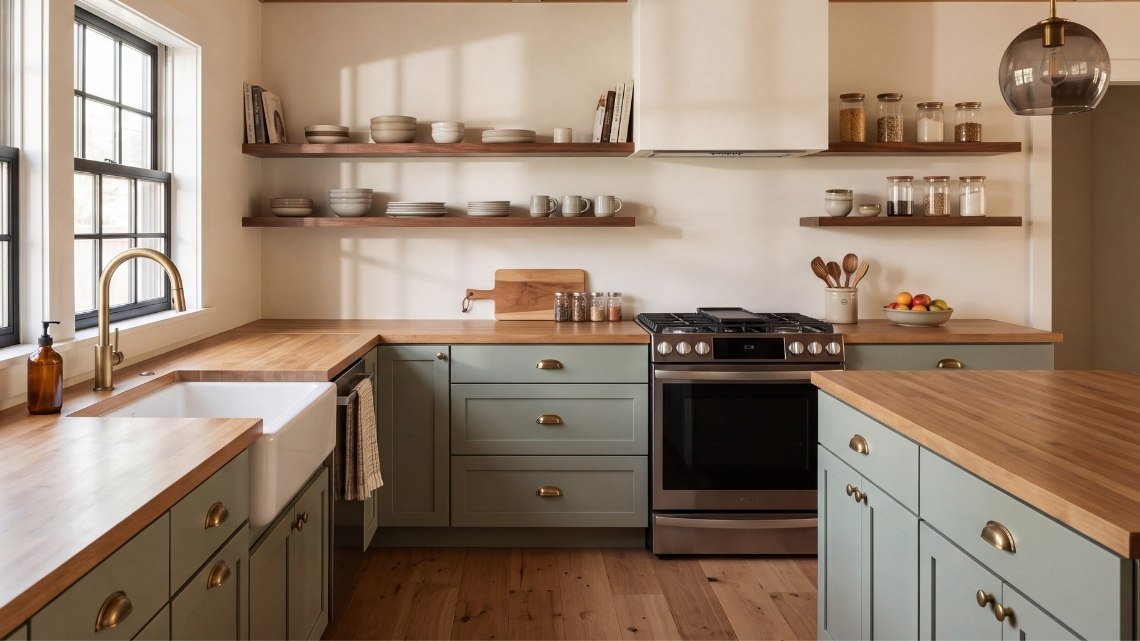
Reviewing cabinet construction before placing an order is the most effective way to avoid these issues later. Use this checklist when comparing options or evaluating a cabinet quote.
- Verify panel thickness. Ensure side, bottom, and shelf panels are sufficiently thick to maintain structural integrity and prevent bowing under load.
- Confirm core box materials. Verify whether the cabinetry features all plywood cabinet boxes rather than particleboard or MDF carcasses.
- Inspect corner joinery techniques. Ask how cabinet corners and structural panels are joined and reinforced, since joint strength depends on the joinery method, materials, fasteners, and assembly.
- Check back panel construction. A substantial, well-fastened back panel helps keep the cabinet box square during installation and use.
- Ask about sink base and dishwasher cabinet construction specifically. These high-moisture zones can benefit from plywood or other moisture-resistant box materials.
- Request a physical sample when possible. A sample box or panel shows core material, layering, and edge quality more clearly than a specification sheet alone.
- Ask what substrate is used for shelves. Thicker plywood shelves offer enhanced sag resistance under heavy cookware and dishes.
Working through this checklist with a design-build contractor before finalizing a kitchen layout gives homeowners a clearer picture of what they’re actually paying for, beyond the door style and finish color.
What Affects the Cost of Plywood Cabinet Boxes?
Plywood cabinet box pricing depends on specific project parameters rather than standard flat rates. Plywood grade, panel thickness, joinery specifications, cabinet dimensions, and configuration can affect cabinet pricing.
Other variables that typically influence pricing include:
- Plywood grade and veneer species
- Custom versus stock or semi-custom sizing
- Soft-close hardware and drawer glide upgrades
- Site access and existing kitchen layout
- Overall project scope, including whether cabinetry is part of a larger remodel
Because every kitchen layout and cabinet order is unique, consulting directly with a professional contractor provides the most accurate estimate based on your specific space, material choices, hardware options, and installation scope.
When Should You Call a Professional?
Consulting a professional design-build contractor or cabinetry specialist is recommended whenever planning major layout adjustments or addressing visible box structural wear near plumbing areas.
A professional can also evaluate whether existing cabinet boxes are structurally sound enough for cabinet refacing or if full cabinet replacement is recommended based on overall condition.
Frequently Asked Questions
What is the difference between framed and frameless cabinet construction?
Framed cabinets have a face frame attached to the front of the cabinet box, while frameless cabinets rely more heavily on the box panels themselves for structure. Both can perform well when properly built. The choice often affects appearance, interior access, hinge configuration, and how the cabinets are installed.
Should cabinet interiors be finished or left as exposed plywood?
Either can be appropriate depending on the cabinet line and design goals. Finished interiors can be easier to wipe clean and provide a more uniform appearance, while exposed or clear-coated plywood can highlight the material itself. Homeowners should check how the interior surface is sealed and how easily it can be maintained.
Are adjustable shelves better than fixed shelves?
Adjustable shelves provide more flexibility for changing storage needs, while fixed shelves can contribute additional rigidity depending on how the cabinet is constructed. Many kitchens use a combination of both based on what will be stored in each cabinet.
Does cabinet box construction affect how cabinets are installed?
Yes. Cabinet weight, panel thickness, back construction, and fastening points all affect how securely the boxes can be anchored and leveled. Proper installation is especially important for wall cabinets, where the box and mounting system must safely support stored items.
What should homeowners compare when looking at two cabinet brands?
Compare more than door style and price. Review box material, panel thickness, back construction, shelf material, drawer construction, hardware, finish quality, warranty terms, and installation requirements. Looking at those details makes it easier to compare overall construction quality rather than appearance alone.
Ready to Plan Cabinetry Built to Last in Your Kitchen?
Grain & Steel Contracting LLC works with Fairfield County homeowners on kitchen remodels that focus on what matters beneath the surface, including durable plywood cabinet box construction, functional layout planning, and high-quality materials built to last.
Consulting with our team helps design and build durable, high-performing cabinetry customized to your kitchen.